Wednesday, 11 April 2012

Viewer Or Voyeur?

Below are my thoughts on the morality of photography as a means of reporting violent world events. Are the images we see in the media too graphic? Or are they necessary in our learning about the world?

When Colonel Gadafi was executed, I remember seeing scenes on the news & in the papers of his bloodied body being dragged through the streets. Despite the gravitas of that situation, I’m not sure the graphic nature of the images chosen to depict the event in the media can really be justified. Seeing that image plastered on the internet, across TV channels, and along the newsstand shelves at the local corner shop really shocked me and stuck in my mind. But then again, I suppose that was the idea...


After watching a documentary about war photographer Don McCullin, having heard him talk about the “darkness” in him, and his experiences having “left him with an untrustworthy outlook on humanity”, I can’t understand how someone could subject themselves to sights such as this without coming away mentally scarred. I personally couldn’t do it.


McCullin remarks on his days as a war photographer "I'm not what you'd call clean...there were moments when I was excited about it, which was totally wrong." Does this make him a voyeur?

Having said this, I have to admit that while reading this 2010 article from the Guardian (below), regarding the media's coverage of the stoning of a man in Somalia, I felt compelled to seek out the mentioned images for myself. This doesn’t, however, mean I enjoy viewing them. There is a certain thrill, an adrenaline rush, when you see something out of the ordinary. It is the same horror movies and roller coasters are so popular.


http://www.guardian.co.uk/artanddesign/2010/mar/08/world-press-photo-sean-ohagan

In the long run, if you remove the camera from the situation, such as this brutal execution in Somalia, it isn’t going to stop it. So, in one respect these images are merely bringing issues such as war, execution etc into the light. They show viewers things they would not know existed otherwise, who are then able to see the truth about the world and voice their opinions on such matters, but not, necessarily, be directly effected by them. 

Tuesday, 3 April 2012

Lenscratch "Animals" Launch!

Having been following the well-known photography blog ‘Lenscratch’, I recently noticed there was an opportunity to take part in several online exhibitions. I chose to enter this image (below, entitled "Eye To Eye") into the exhibition entitled ‘Animals’, in an attempt to spread my work more widely around the web!


Having successfully submitted it, yesterday brought about the launch of "Animals". Myself and several of my fellow students were lucky enough to have our work shown!


Visit Lenscratch here! http://www.lenscratch.com/

Monday, 2 April 2012

Guest-Speaker Rasmus Vasli's "Photographing Strangers"

Artist Rasmus Vasli conducted a lecture describing his work with portrait photography. He explained his haphazard technique of going on walks with his camera, no concept in mind, and simply shooting portraits of people he'd see on the street, having spoken to them and asked their consent.
"A Proud Man"


I really like this style of shooting, because although it's not entirely natural - the subjects are still very much aware of the camera's presence and so somewhat pose - the lens captures them in a freeze-frame of their everyday lives. They have no time at all to prepare how they will look, and are captured within their normal surroundings with natural light, as opposed to in a studio set-up. 


In his blog, entitled "Cup Of Pea", Vasli accompanies each image with a short caption about what he learnt from talking his subject. This is the only contextual information we directly receive. Otherwise, it is up to us to determine the character of each photographed person, drawing ideas from their surroundings, clothing and expression.


"Derek"

For a better look Rasmus Vasli's work, here is the link to his blog "Cup Of Pea" -
http://cupofpea.blogspot.co.uk/

Tuesday, 20 March 2012

Guest-Speaker Marcio Mascarenhas

We were lucky to have Brazilian photographer Marcio Mascarenhas visit Solent today, who gave a presentation on his portraiture work. 
In his project "I is an Other", Mascarenhas attempts to depict the different pieces of someone's personality, the many aspects of their character - we are never just one person; we are changeable. 


As he stated "You don't exist if no one is there to see you", I realised how the dependence upon another to reveal your own self is important in our society. 


Mascarenhas goes down a similar route with another of his projects, entitled "The Bodies I Live In". This too outlines his ideas on identity, but now places an emphasis on gender and race in each frame.


For instance, in this image, the female subject is shot firstly in a way that highlights her feminine figure, with directional lighting picking out the curved shapes of her body. However, her lower body has been interjected by a far more masculine frame.
Although the parts of this piece do not necessarily match up, our subject remains consistent, as does her sense of vulnerability, with her hands folded across her body in each part of the photograph. This could reflect the fragility of the human personality, as well as the way in which we are all so susceptible to change. 
The way these large-scale photographs are presented - each of them cut up and placed against further images of the same subject but from a different perspective - refers, again, to the many personas we adopt throughout our lives. 

Wednesday, 14 March 2012

Taylor Wessing Portrait Prize, National Portrait Gallery

The Taylor Wessing Portrait Prize showcased a shortlist of sixty photographs taken by a wide range of talented, albeit lesser-known photographers, many of which have stuck in my mind. This image of Dolly Parton, taken by Zed Nelson in 2011, is one of those.


Being one of the few photographs within the show portraying a famous subject, I believe makes this image even more poignant. So used to seeing her within the context of the glamourous lifestyle of a singer, we now witness a quiet, almost fragile woman, complete with contemplative expression. Parton's unawareness of the photo being shot, allows us to see a different side of her character. 


Another image I found particularly compelling is "Erika E. Born In 1910" (below) by Karsten Thormaehlen. Taken from a series called "Happy At One Hundred", this image has an air of dignified positivity radiating from it; a quality little-found throughout the rest of the exhibition. I love the detail of each line upon the subject's face, along with the slight smile upon her lips, each giving viewers a sense of her character.


Similarly, "Anna and Roberto At Home" by Claudia Burlotti, I believe should have been one of the winning portraits from the whole exhibition. This heart-warming image, capturing a loving moment between the photographer's grandparents, depicts genuine emotion caught spontaneously on camera. 


Unlike the winner of the Taylor Wessing prize, I feel Burlotti's photograph depicts the raw emotion that a reliable portrait should encompass. Here, you are able to learn something about the relationship between the subjects, whereas in Jooney Woodward's "Harriet & Gentleman Jack" (The winning portrait, shown below), this attribute is somewhat lost. 


For more information on the Taylor Wessing Portrait Prize, as well as other exhibitions, take a look at the National Portrait Gallery site - http://www.npg.org.uk/

Giorgio Ciam, Mummery & Schnelle Gallery

During a trip to London, I visited the lesser-known Mummery and Schnelle Gallery. Here, I discovered the work of experimental photographer Giorgio Ciam, who produced blurred images through the movement of his subjects and a long exposure. This is in order to obscure the identity of those in his photographs who, I learned, are often the artist himself with a friend. 


This work is reminiscent of that of Francesca Woodman, whose well-known images were produced through similar processes to Ciam's. 
Using long exposures, Woodman's work (shown below) depicts the troubled artist in a series of disturbing nude self-portraits created in the lead up to her eventual suicide in 1981. In the majority of her images, it is evident that the artist is trying to hide away from the lens, to blend into her derelict surroundings, thus resulting in a type of "anti-portrait" in which the subject cannot always be seen. She achieves this, again, by using movement and blurring, as well as objects within her setting - such as peeling wallpaper, furniture and large photographs - to hide behind.


Although eerie and subsequently tragic, I find this work rather beautiful, with the surreal effect of long exposure giving them an ethereal quality.  


Wednesday, 7 March 2012

Sophie Rickett's "To The River" at The Arnolfini Gallery, Bristol

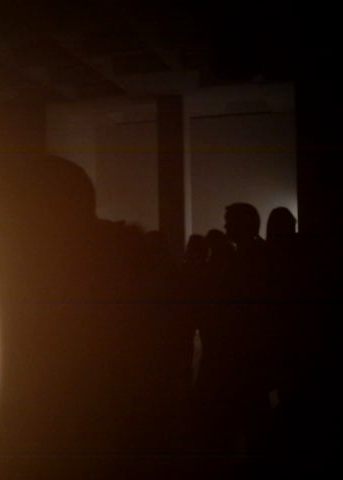
As I entered the dark hall in which Rickett’s work was showcased, I felt completely enveloped by it. The atmospheric whispers of the viewers of the Severn Bore - a wave that rarely runs down the length of the River Severn - filled the room, coming from a total of twelve speakers dotted throughout. This was accompanied by several large screens (one shown below), upon which were shown clips of the spectators waiting on the river bank at night. Despite being the main reason for the subject's presence, there is very little emphasis on the landscape, with the bore never actually being filmed. Instead, the focus is placed upon the anticipation of the crowd in relation to this natural phenomenon.   


This was quite a surreal experience; standing in a large dark room, surrounded by others, wondering if it was the voices of the subjects I could hear or those of my fellow students. In this sense, the show is completely immersive, making you feel like you are among the group of excited bystanders.   


Spectators in the darkened space of Rickett's "To The River"